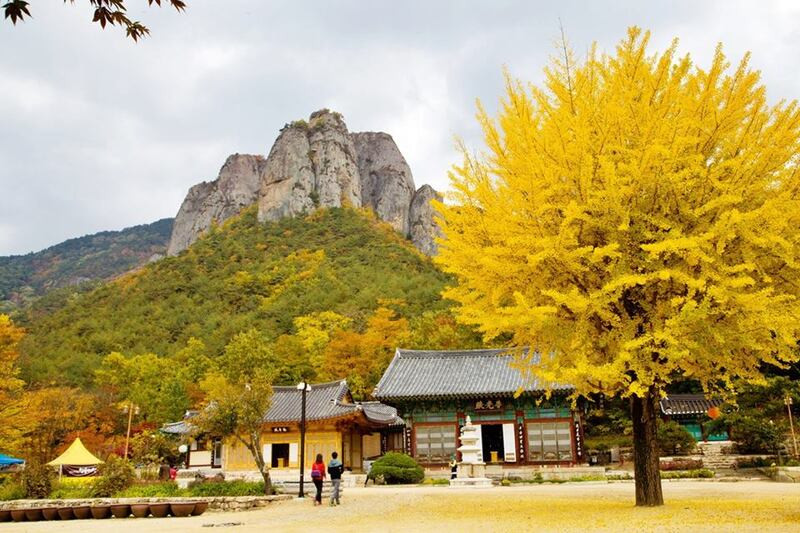
Top 15 Busan Attractions for 2026: Opening Hours, Ticket Prices, Subway

Busan is a port city with many layers of experience: from Haeundae’s fine sandy beach, the brilliantly lit Gwangan Bridge at night, the colorful Gamcheon Culture Village, to Haedong Yonggungsa Temple right beside the waves. For independent Vietnamese travelers, 15 the places below are worth considering for an itinerary of 4 to 5 days, along with opening hours, ticket prices updated in 5/2026, and the nearest subway.
Summary table of 15 Busan attractions
The table below helps you quickly check the important information before your trip, especially convenient to save on your phone. The figures were updated in 5/2026 from Visit Korea, Visit Busan, and the Korea Tourism Organization.
| # | Attraction | Khu | Opening Hours | Ticket Price | Nearest Subway |
|---|---|---|---|---|---|
| 1 | Haeundae Beach | Haeundae-gu | 24/7 | Free | Haeundae (Line 2) |
| 2 | Gwangalli Beach + Gwangan Bridge | Suyeong-gu | 24/7 | Free | Gwangan (Line 2) |
| 3 | Songdo Beach + Marine Cable Car | Seo-gu | 9h-21h cable car | Cable car about 20.000 KRW | Songdo Beach (Line 1) + bus |
| 4 | Oryukdo Skywalk | Nam-gu | 9h-18h, in summer until 19h | Free | Bus 27 from Kyungsung Univ Station |
| 5 | Gamcheon Culture Village | Saha-gu | 24/7 | Free | Toseong (Line 1) + bus 2 |
| 6 | Huinnyeoul Culture Village | Yeongdo-gu | 24/7 | Free | Nampo (Line 1) + bus 7/71/508 |
| 7 | BIFF Square + Gukje Market | Jung-gu | 24/7, food stall 10h-22h | Free | Jagalchi/Nampo (Line 1) |
| 8 | Haedong Yonggungsa Temple | Gijang-gun | 5h-19h | Free | Bus 181 from Haeundae Station |
| 9 | Beomeosa Temple | Geumjeong-gu | 8h-17h | Free | Beomeosa (Line 1) |
| 10 | Busan Tower + Yongdusan Park | Jung-gu | 10h-22h | About 12.000 KRW | Nampo (Line 1) |
| 11 | SEA LIFE Busan | Haeundae-gu | 10h-19h | 35.000 KRW, online about 24.000-29.000 KRW | Haeundae (Line 2) |
| 12 | Haeundae Sky Capsule | Haeundae-gu | 9h30-18h to 20h30, depending on the season | 35.000-50.000 KRW/cabin | Haeundae (Line 2) + bus |
| 13 | Seomyeon | Busanjin-gu | 24/7, store hours 10h-22h | Free | Seomyeon (Line 1 + Line 2) |
| 14 | Jeonpo Cafe Street | Busanjin-gu | 10h-23h | Free | Jeonpo (Line 2) |
| 15 | Jagalchi Fish Market | Jung-gu | 5h-22h, closed on 3 of weeks 1 and 3 | Free | Jagalchi (Line 1) |
Sea and ocean views: 4 places worth visiting
The four places below best show Busan’s beauty as a port city. Each has its own character: lively Haeundae, beautiful Gwangalli at night, Songdo for a cable car experience, and Oryukdo for a more rugged feel.
Haeundae Beach
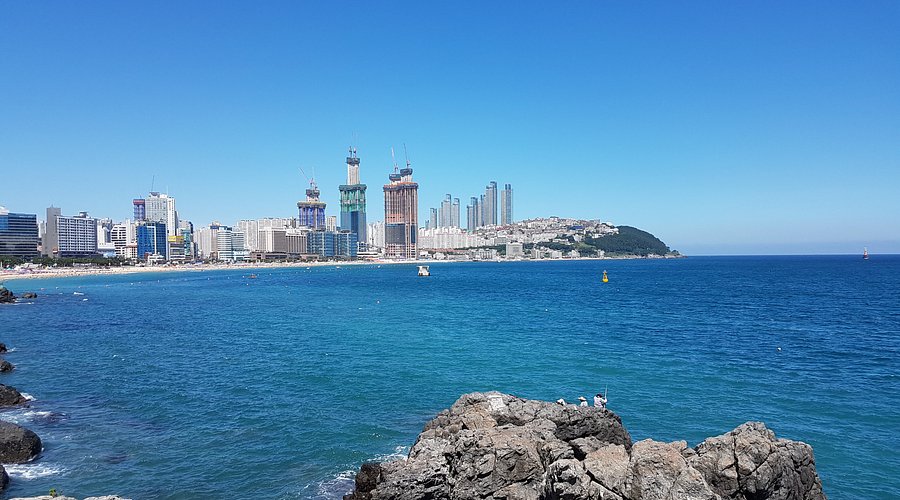
Haeundae Beach is Busan’s most famous beach, about 1,46 km long, known for its fine sand and clear blue water from 5 to 9. It’s a great place to swim, stroll, take photos, or simply enjoy the sea air.
The best time to visit Haeundae is before 7 a.m. At this time, the beach is still quiet, the light is soft, the wind moves through the pine trees, and locals begin their morning runs. The beach is open 24/7 and there is no entrance fee. Sunset photo tip at Haeundae: ISO 200, f/8, shutter speed 1/125s, combined with an ND filter to preserve the detail in the sand and clouds.
Gwangalli Beach and Gwangan Bridge
Gwangalli Beach is about 1,4 km long, and its waves are gentler than Haeundae’s, so it’s quite suitable for families with young children. However, what makes Gwangalli one of the most worthwhile places to visit in Busan is Gwangan Bridge.
Gwangan Bridge is 7,42 km long and is South Korea’s second-longest bridge after Incheon Bridge. In the evening, more than 7.000 LED lights on the bridge create a dazzling scene, especially from 19 p.m. to 23 p.m.
If you want to photograph Gwangan Bridge at night, you can use a long exposure5to10 gso the photo has a shimmering postcard-like effect. Two common shooting angles are from the southern sandy area or from the high-floor cafes facing the bridge.
The couple Tran Minh Hieu and Pham Quynh Anh, 30 and 28 years old, freelance designers in Hanoi, who visited Busan in 11/2025, shared: “We booked a hotel on the 14 floor with a direct view of Gwangan Bridge. At 8 p.m. we turned off the lights and watched the LED lights move to the music. It was even more beautiful than Vietnamese New Year fireworks.”
Songdo Beach and Marine Cable Car
Songdo Beach is South Korea’s first public beach, opened in 7/1913. Located in Seo-gu, it is now known to many visitors for the Busan Air Cruise, a cable car line about 1,62 km long and 86 m above sea level.
The cable car line connects Songnim Park in the east with Amnam Park in the west. Visitors can choose one of two cabin types:
- Standard Cabin: regular cabin with a wide view.
- Crystal Cabin: a cabin with a transparent glass floor, offering a direct view down to the sea.
Operating hours change by season. From 12 to 2, the cable car runs from 9h-20h. From 3 to 6 and 9 to 11, the cable car runs until 21h. In 7 and 8, hours are extended until 22h. Ticket counters usually close about 30 minutes before the end time.
Oryukdo Skywalk
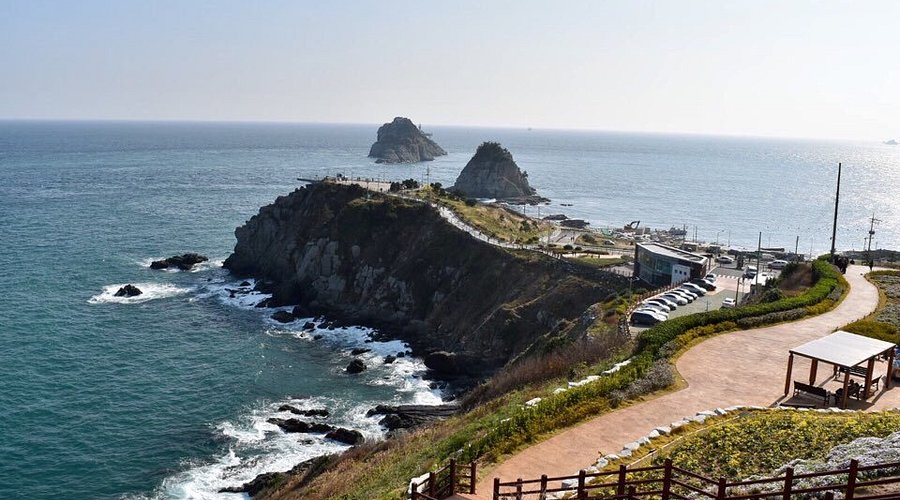
Oryukdo Skywalk is a horseshoe-shaped glass platform with 24 glass panels, about 15 m long and located on a 35 m-high sea cliff. It is a free seaside viewpoint, suitable for those who enjoy standing high above the waves.
From 10 to 5, Oryukdo Skywalk is open 9h-18h. From 6 to 9, it stays open until 19h. Before stepping onto the glass deck, visitors need to wear the shoe covers provided at the entrance to protect the glass surface.
In case of rain, snow, or strong winds, the glass deck area may close for safety reasons. If you want photos with fewer people, it’s best to go early in the morning or near closing time.
Culture and old villages: 3 signature Busan spots
The three places below preserve part of Busan’s wartime story, while also showing how the city has transformed into an artistic, youthful, and identity-rich destination.
Gamcheon Culture Village
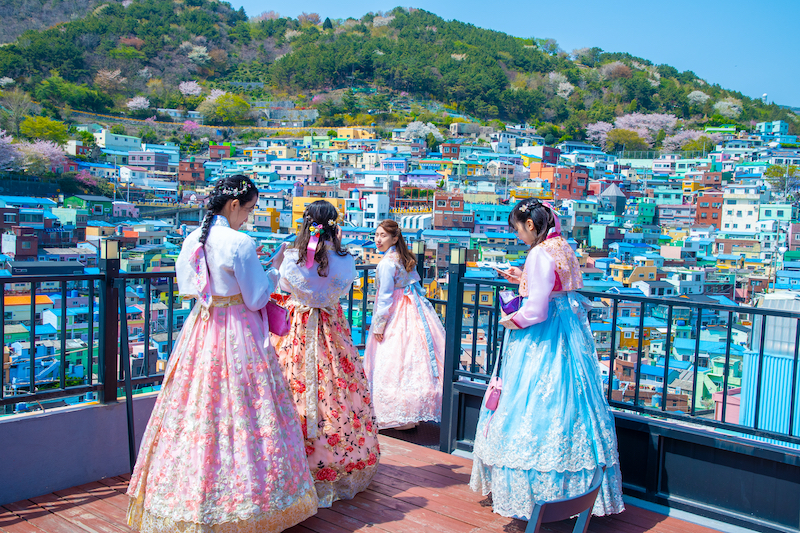
Gamcheon Culture Village is often called the “Machu Picchu of Korea” thanks to its densely packed small, colorful houses on the hillside. This area was once home to more than 800 refugee households during the Korean War in the 1955. In 2009, the “Dream of Busan’s Machu Picchu” project was launched, turning Gamcheon into a famous art village.
Today, Gamcheon has many small alleys, murals, cafes, and exhibition spaces scattered throughout the residential area. When visiting here, you should wear flat shoes because the roads are quite steep and have many steps. The ideal time to explore the main alleys is about 2 to 3 g hours. The village is open 24/7 and there is no admission fee.
Huinnyeoul Culture Village
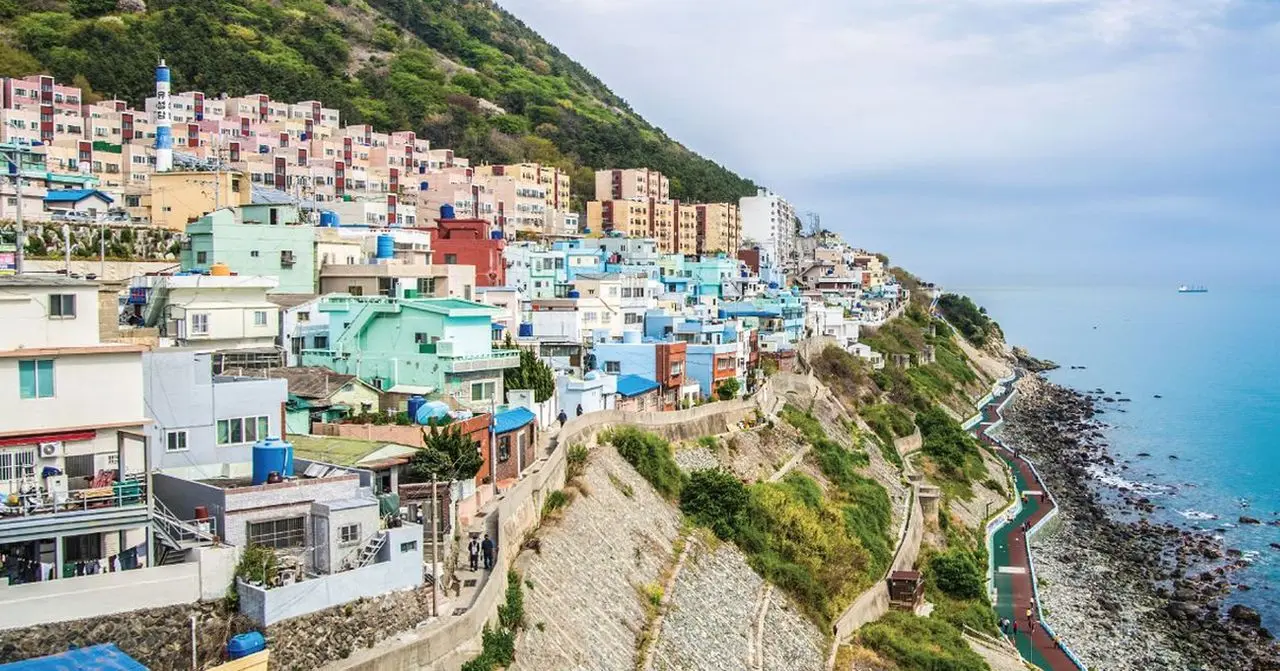
Huinnyeoul Culture Village is located in Yeongseon-dong, Yeongdo-gu, and is often compared to the “Santorini of Korea.” White houses sit on the seaside cliffs overlooking Namhangaegyo Bridge and moored ships, creating a very distinct Busan scene.
Originally, this was a small fishing village. After the war, this area received many refugees, making the alleyways narrow but also full of everyday life. Since month12/2011, many old houses have been renovated into workshops, independent bookstores and cafes.
The village has 14 narrow alleys and was once a filming location for the movie “The Attorney” in 2013, starring Song Kang-ho. From Nampo Station exit 6, you can take bus 7, 71, or 508 to Baengnyeonsa stop, with a travel time of about 10 minutes. Huinnyeoul is open 24/7 and free to enter.
BIFF Square and Gukje Market
BIFF Square was named on 13/9/1996 ahead of the first Busan International Film Festival. Before that, the area already had nearly 20 cinemas operating since the 1960, so it has long been associated with Busan’s film culture.
Right next to BIFF Square is Gukje Market, founded in 1950 during the Korean War as a place for refugees to make a living. Today, it is one of the largest traditional markets, known for its long-established street food stalls.
Two dishes worth trying when visiting this area:
- Ssiat Hotteok: crispy fried pancake filled with seeds, about 1.500 KRW each.
- Bibim dangmyeon: spicy mixed glass noodles, about 5.000-7.000 KRW per bowl.
The area is free to enter. The stalls usually open from 10 a.m. to 22 p.m. and are busiest after 18 p.m.
Spirituality and history: 2 iconic temples
The two temples below represent two different facets of Korean Buddhism in Busan: one is a seaside temple right by the waves, and the other is a quiet mountain temple among pine forests.
Haedong Yonggungsa Temple
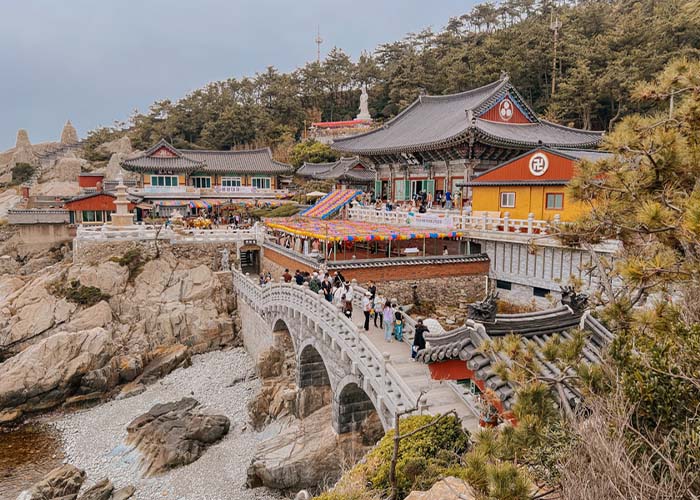
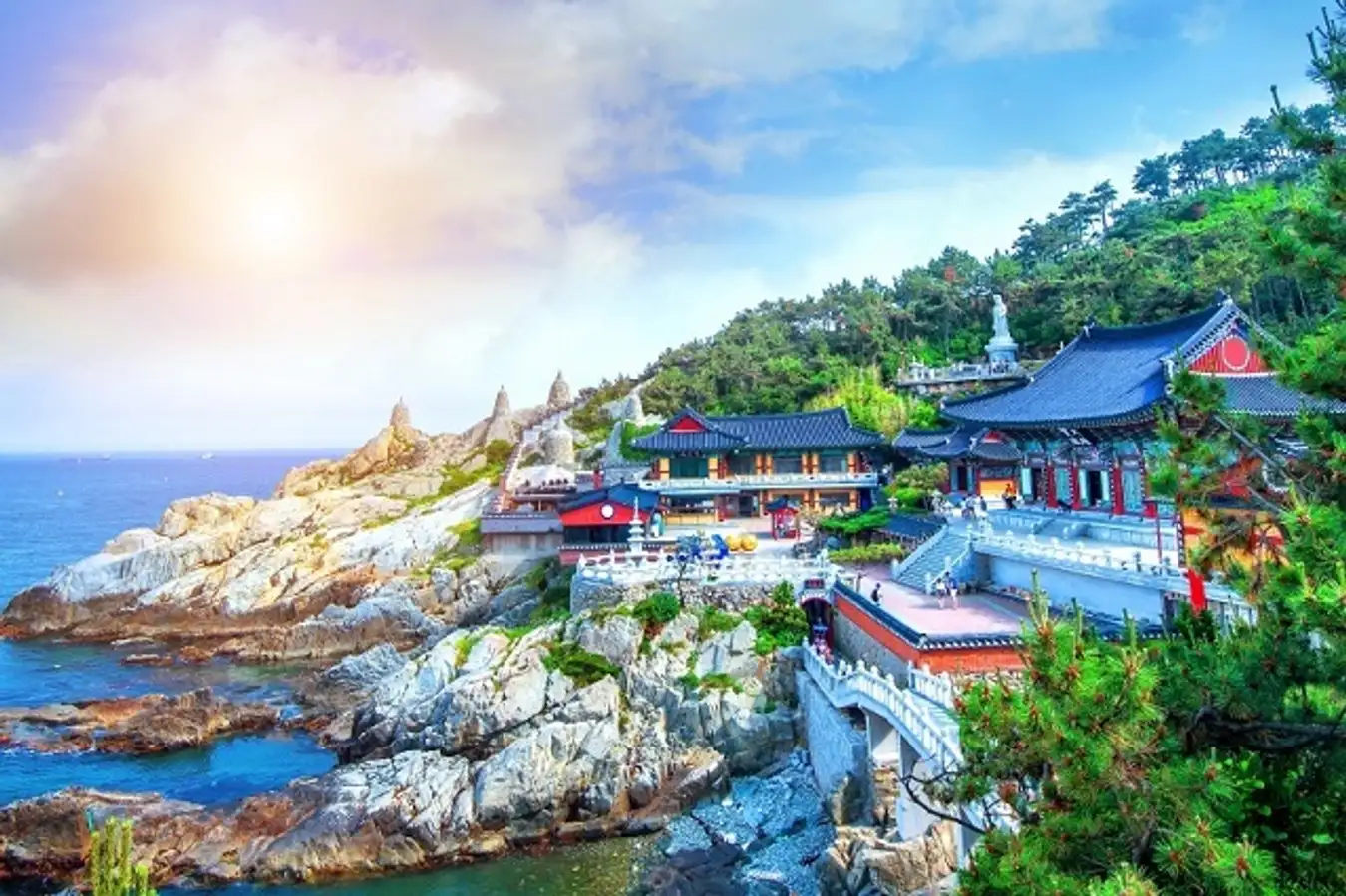
Haedong Yonggungsa is regarded as one of the three sacred sites dedicated to the Bodhisattva Avalokiteshvara in Korea. The temple is said to have been founded in 1376 during the Goryeo Dynasty by the monk Naong, and later restored in the early 20 century after the Imjin War.
What makes Haedong Yonggungsa special is its location on a rocky shoreline in Gijang-gun. Waves crash right below the main hall, creating a rare scene compared with many Korean temples that are usually located in the mountains.
The best time to visit the temple is around 5-6 a.m., when the sunrise shines on the roof tiles and the surroundings are still quite peaceful. From Haeundae Station exit 7, take bus 181, which runs about every 17 minutes, with a travel time of about 45 minutes. The temple does not charge an entrance fee.
Beomeosa Temple
Beomeosa Temple was founded in 678 during the Silla period by the monk Ui Sang, and is located on Geumjeongsan Mountain. It was burned down during the Imjin War 1592-1598, then restored in 1613 and developed into one of the six largest temples in Korea.
Beomeosa is also a center of Seon meditation, equivalent to Zen in Japanese Buddhism. In 10 and 11, the road up to the temple is covered in red autumn leaves, making it ideal for those looking for a slow, quiet atmosphere.
The temple is open 8h-17h and free to enter. You can take the subway to Beomeosa Station on Line 1, exit at 5 or 7, walk about 5 minutes to the bus stop, then take bus 90 for another 15 to 20 minutes to reach the temple gate.
See also: Seoul travel itinerary 2026: detailed 3, 5, and 7-day plans
Panoramic views and entertainment: 3 high-view Busan spots
The three places below are suitable for travelers who want to see Busan from a different angle. Each offers a distinct experience: viewing the city from a tower, exploring the ocean indoors, or riding a slow cabin along the coast.
Busan Tower and Yongdusan Park
Busan Tower is 120 m tall and located in Yongdusan Park in the Nampo area. Tickets to the observatory cost about 12.000 KRW, and opening hours are 10h-22h. The best time to go up the tower is at sunset, when you can see Busan Port and Yeongdo Island. In 10 and 11, if the weather is clear, visitors can also see Japan’s Tsushima Island in the distance.
Sunset photo tip at Busan Tower: ISO 400, f/2.8, shutter speed 1/30s. The best time is usually 18h-19h in 4 or 17h-18h in 11.
SEA LIFE Busan
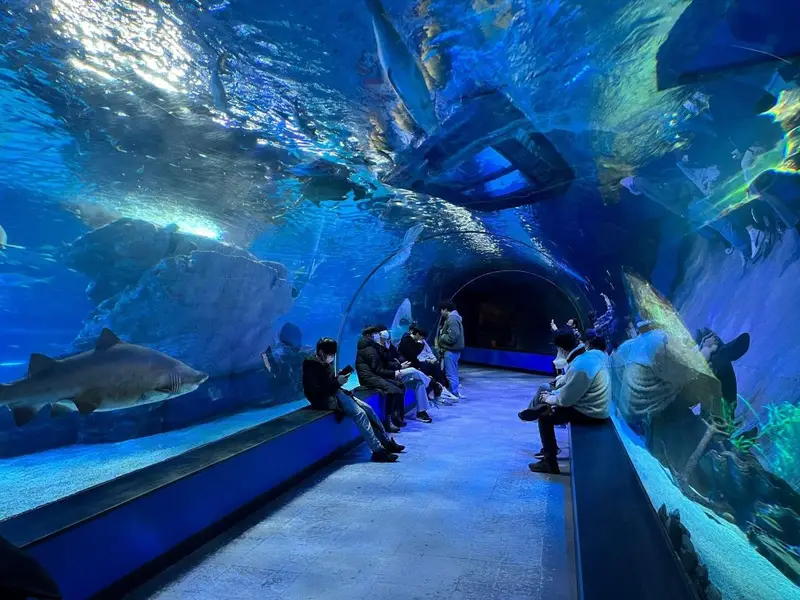
SEA LIFE Busan is an aquarium right next to Haeundae Beach. It has more than 10.000 marine creatures, exhibition zones, feeding tanks, and interactive areas, making it a great choice for families with children.
Adult tickets at the counter are 35.000 KRW. If you book online through Klook or KKday, the price is usually around 24.000-29.000 KRW. SEA LIFE Busan is open 10h-19h, and the average visit takes about 2 to 3 g hours.
Haeundae Sky Capsule
Haeundae Sky Capsule is a row of colorful cabins running on elevated tracks, connecting Mipo Station near Haeundae with Cheongsapo Station. The line is about 2,3 km long, and the ride takes about 30 minutes at a slow speed of about 4 km/h.
Cabin ticket prices:
- 35.000 KRW for 1-2 people per cabin.
- 45.000 KRW for 3 people.
- 50.000 KRW for 4 people.
Each cabin holds up to 4 people. Operating hours vary by season: from 11 to 2 it runs until 18h, from 3-4 and 10 it runs until 18h30, from 5-6 and 9 it runs until 19h30, and from 7-8 it runs until 20h30. Sky Capsule tickets often sell out at the counter, so it’s best to book online 2 to 3 days in advance through Klook or the Blueline Park website.
Streets, shopping, and dining: 3 lively districts
If Busan is beautiful during the day for its beaches and hillside villages, then at night the city becomes even more lively in its shopping, cafe, and food districts. The three areas below are well worth adding to your itinerary if you want to experience the local pace of life.
Seomyeon
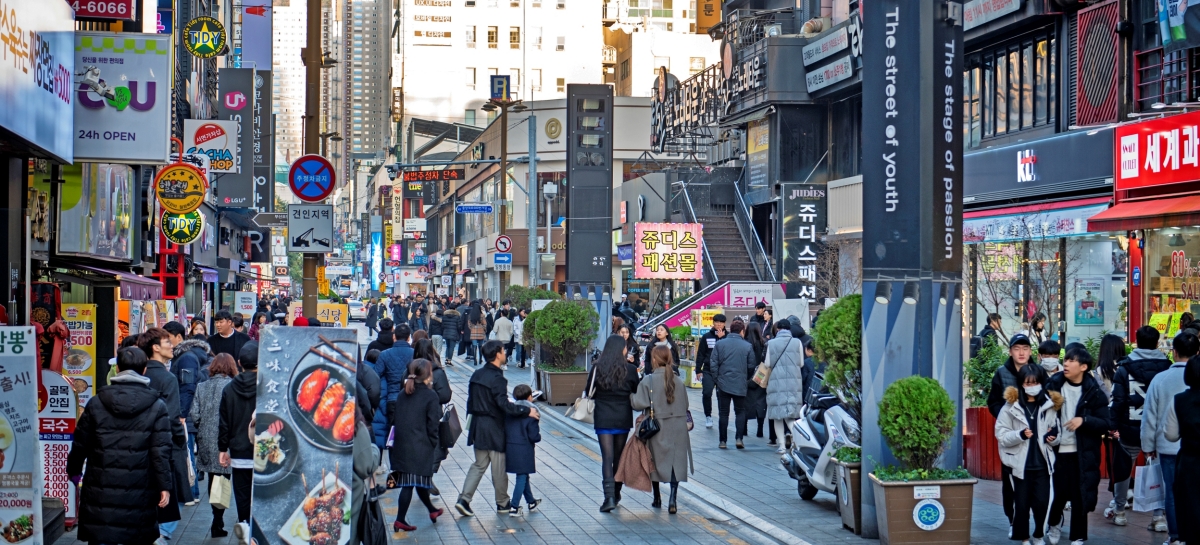
Seomyeon is Busan’s central district, where subway Line 1 and Line 2 g intersect. It is a popular base for first-time visitors because it is convenient for getting around, has many budget hotels priced around 70.000-100.000 KRW per night, and offers plenty of dining options from BBQ to milmyeon.
Seomyeon Underground Shopping Street stretches for a full kilometer, making it ideal for shopping, avoiding rain, or taking an evening stroll. The area stays busy until around 23 p.m., making it a good choice for those who want to stay in the city center with many amenities nearby. The Seomyeon area is free to enter.
Jeonpo Cafe Street
Jeonpo Cafe Street was once selected by The New York Times as one of “52places to visit in the year2017”. Previously, this area was a mechanical workshop street. Since the year2009, this place has gradually transformed into a city of specialty coffee, brunch, and small shops with their own distinct style.
From Jeonpo Line 2, it’s about a 5-minute walk to the cafe street. The cafes are usually open from 10h to 23h, with average drink prices of about 5.000-8.000 KRW.
On weekends, this area is quite busy and many places have queues. If you want a good seat, it’s best to come in the morning around 10h-11h or after 21h.
Jagalchi Fish Market
Jagalchi Fish Market is South Korea’s largest seafood market. It opens from 5 a.m. to 22 p.m. and is closed on the 3 of the first and third weeks of each month. The 1 floor is the fresh seafood sales area, with a lively atmosphere, the calls of vendors, and a very distinctive ocean smell. The 2 floor is the sashimi restaurant area. You can choose live fish on the 1 floor, then bring it up to the 2 floor to have the restaurant prepare it for a service fee of about 5.000 KRW per person.
A portion of snow crab or white-fish sashimi usually ranges from 25.000-50.000 KRW depending on size. The market mainly accepts cash, so it’s best to bring at least 30.000 KRW when you go to eat.
See also: Self-guided Seoul travel cost 2026: 13-25 million per person for 5 days
How to choose places by season and interests
Not every traveler needs to visit all 15 places. Depending on your time, travel season, and trip style, you can choose the most suitable spots.
Choose places by traveler type
- Couples who love taking photos: Gwangalli and Gwangan Bridge at night, the Songdo Crystal Cabin cable car, Jeonpo Cafe Street.
- Families with children: SEA LIFE Busan, Haeundae Sky Capsule, Beach Train, Songdo Skywalk.
- Solo travelers who like quiet places: Gamcheon, Huinnyeoul, Beomeosa Temple in autumn.
- Food lovers: Jagalchi Market, BIFF Square and Gukje Market, Seomyeon BBQ.
- First-time visitors to Korea: Haeundae, Gwangalli, Gamcheon, Yonggungsa, and Busan Tower are the 5 places to prioritize.
Choose places by season
- Spring, 3-5: Beomeosa has magnolia blossoms, Sajik Park Road has cherry blossoms, and Haeundae is not too crowded yet.
- Summer, 6-8: Haeundae, Gwangalli, and Songdo are suitable for beach trips; it’s better to avoid Gamcheon at midday because the roads are steep and hot.
- Autumn, 9-11: Beomeosa is beautiful with red leaves, Yongdusan Park is easy for a stroll, and Oryukdo Skywalk offers clear ocean views.
- Winter, 12-2: Spa Land Centum City, the BIFF night market, and the Gwangbok-ro light festival are better choices than outdoor attractions.
When should you not go to Busan?
There are two periods that Vietnamese travelers should consider before planning a trip to Busan.
- First is the first week of 7. This is a period when showers are more likely, with humidity around 80-85%. Outdoor spots such as Gamcheon, Oryukdo Skywalk, or Yonggungsa Temple may be difficult to visit, and may even close if there is heavy rain or strong wind.
- Second is Chuseok week, the Korean Mid-Autumn Festival. During this period, many traditional shops such as Jagalchi Market, BIFF Square, and Gukje Market may close for 2 to 3 days. Taxi fares may rise by 20-30%, and hotels are also more likely to be fully booked.
In 2026, Chuseok falls on 24-26/9. If possible, you should avoid booking a trip during this period. If you do travel during Chuseok, prioritize open 24/7 attractions such as Haeundae, Gwangalli, Huinnyeoul, or large spa complexes like Spa Land Centum City.
Suggested day-by-day combined itinerary
To save travel time, it is best to group attractions in the same area or in the same direction into one day. Below are easy-to-follow 4 g suggestions:
- Beach day: Haeundae in the morning, Gwangalli in the afternoon, Gwangan Bridge at night.
- Cultural day: Gamcheon in the morning, BIFF Square and Gukje Market at midday, Busan Tower at sunset.
- Spiritual day: take bus 181 to Yonggungsa at sunrise, then stop by Oryukdo Skywalk, and relax in the afternoon at Spa Land Centum City.
- City day: Seomyeon at noon, Jeonpo Cafe Street in the afternoon, and sashimi dinner at Jagalchi Market at night.
Ms. Nguyen My Linh,28years old, traveling to Busan from12to16/04/2026and can be combined11/15points in5days, shared: “The hardest part is balancing time and energy. On the first day, I tried to go5the point was exhausted, then I pulled back2-3main points and1a rest-stop cafe. I finish early every day and feel more at ease.
Korean eSIM for easy travel between attractions
An eSIM is a convenient choice when moving between 15 attractions spread across different districts of Busan. A stable 4G connection helps you use Naver Map, check buses, call taxis via Kakao T, and translate quickly with Papago.
In Korea, Google Maps does not show walking directions as accurately as in many other countries due to security regulations. So if you do not have stable internet, it is very easy to get lost, especially when visiting places like Yonggungsa, Huinnyeoul, or Oryukdo Skywalk.
SIMPM provides Korean eSIM using KT network, one of the three major mobile carriers in Korea alongside SK Telecom and LG U+.
SIMPM eSIM plans for a Busan trip
Vietnamese travelers to Busan usually choose one of the following three plans:
- 5GB/5-day plan, price 280.000 VND: suitable for a 4-5 day trip, combining about 6-8 spots.
- 10GB/7-day plan, price 480.000 VND: suitable for longer trips or when you need to post lots of photos and videos.
- 3GB/3-day plan, price 180.000 VND: suitable for a short weekend trip, covering about 4-5 spots.
All plans include 4G/LTE with unlimited speed and support 24/7 from the SIMPM hotline in Vietnamese.
Purchase and activation
You can order a Korean eSIM at SIMPM and receive the QR code by email within about 5 minutes. After scanning the QR code once, simply activate the eSIM on your departure day and you will have 4G as soon as you land at Gimhae Airport. The 5GB/5-day plan priced at 280.000 VND is now available on the SIMPM Korean eSIM booking page.
Busan attracts visitors with its blue sea, colorful cultural village, seaside temples, and vibrant food districts. If you are planning an independent Busan trip in 2026, the 15 places below will help you easily choose where to go, check opening hours, ticket prices, and how to get there by subway. Don’t forget to prepare a Korea travel eSIM from SIMPM so you can use Naver Map, check directions, call a ride, and stay connected with a stable 4G throughout your trip.